Knitting for Beginners: 12 Easy First Projects
Quick summary
- Chunky yarn on thick needles shows progress fast, which is what keeps a first project going.
- Edges that widen row by row are added stitches, not bad tension, and the fix is counting.
- Buy all the yarn at once, because dye lots vary and a mid-project top-up never quite matches.
Quick answer: Start with chunky yarn, 8mm needles, and a garter stitch scarf or dishcloth. Learn casting on, the knit stitch, and casting off, which is every skill a first project needs. Count your stitches at the end of each row, since almost every beginner problem turns out to be a stitch accidentally added or dropped.
Have you ever bought a pair of needles and a ball of wool, watched half a tutorial, and put both back in the drawer? You are not alone. Knitting looks like it has a long list of things to learn, and in fact a first finished object needs exactly three of them.
These twelve projects run from the simplest upward. Each lists what it takes, roughly how long it needs, and the detail that decides whether it gets finished or joins the wool in the drawer.
What to Buy First
The wrong yarn is the most common reason a first attempt stalls, and it is bought before anyone has knitted a stitch.
- Chunky or super chunky yarn. Thick yarn means fewer stitches per row and visible progress within an evening. Fine yarn on thin needles is where beginners lose heart.
- 8mm or 10mm needles. Match them to the yarn band, which always states a recommended size. Bamboo grips the yarn better than metal, which matters while your tension is still uneven.
- A light, solid colour. Dark or heavily variegated yarn hides the stitches, and seeing the stitch structure is most of how you learn to read your own knitting.
- A blunt darning needle. For weaving in the ends. The one tool people forget, and the thing that makes a finished piece look finished.
Buy enough yarn for the whole project in one go. Dye lots differ slightly between batches, and a ball bought three weeks later will show as a band across the work. What to buy first across any craft is covered in the best craft supplies for beginners.
12 Easy First Projects
1. Garter Stitch Dishcloth
Needs: cotton yarn, 5mm needles. Time: an evening.
A square of knit stitch in cotton. It is genuinely useful, it is small enough to finish before boredom sets in, and the uneven edges of a first attempt do not matter at all in a sink.
Watch out for: casting on too many stitches. Twenty is a dishcloth; forty is a long evening.
2. Simple Garter Scarf
Needs: chunky yarn, 8mm needles. Time: a weekend.
Cast on about twenty stitches and knit every row until it is long enough. This is the standard first project for good reason: one stitch, no shaping, no counting beyond the first row.
Watch out for: accidental increases at the edges. Count at the end of every row for the first few; after that you will feel it when the number is wrong.
3. Chunky Headband
Needs: chunky yarn, 8mm needles. Time: 2 hours.
A short strip of knitting, sewn into a loop. It finishes in one sitting, which makes it the best option for anyone who wants a complete object today rather than an unfinished one tomorrow.
Watch out for: sizing it tight. Knit fabric stretches far more than woven, so a snug band becomes a loose one within a week of wear.
4. Coaster Set
Needs: cotton yarn, 4mm needles. Time: 30 minutes each.
Small squares in cotton. Making four in a row is the fastest way to see your own tension settle down, because the fourth will be noticeably neater than the first.
Watch out for: wool. It absorbs and holds moisture under a glass. Cotton is the right fibre here.
5. Phone or Glasses Case
Needs: any yarn, matching needles. Time: 2 hours.
A rectangle folded and seamed along two edges. It introduces sewing a seam, which is the next skill after the three basics and takes about ten minutes to learn.
Watch out for: measuring the object, not guessing. Knit to the exact width of the phone and the stretch will do the rest.
6. Cushion Cover Front
Needs: chunky yarn, 8mm needles, a plain cover. Time: a weekend.
Knit a square and sew it onto a plain shop-bought cushion cover rather than constructing the whole thing. All of the visible effect, none of the fiddly back opening. More covers sit in handmade pillow cover ideas.
Watch out for: a square that is not square. Measure as you go rather than counting rows, since row height varies with tension.
7. Hot Water Bottle Cover
Needs: chunky wool, 8mm needles. Time: a weekend.
Two rectangles seamed around a bottle, open at the neck. Wool is the right fibre because it holds heat, and the shape forgives any unevenness.
Watch out for: knitting it to the exact bottle size. Allow a little ease, or it will not go on once the bottle is full.
8. Ribbed Beanie
Needs: chunky yarn, circular needles. Time: a weekend.
The first project that needs the purl stitch and knitting in the round. Both are genuinely easy; they simply look intimidating written down.
Watch out for: twisting the cast-on round. Check that every stitch faces the same way before joining, because there is no fixing it afterwards.
9. Fingerless Mitts
Needs: chunky yarn, circular or double-pointed needles. Time: a weekend.
Tubes with a gap left for the thumb. They introduce a simple shaping decision without any of the complexity of a full glove.
Watch out for: making the pair different sizes. Count the rows on the first one and write the number down.
10. Chunky Throw
Needs: a lot of super chunky yarn, 12mm needles. Time: several evenings.
Scaled-up garter stitch. No new skills at all, just more of the same, and the result is the most expensive-looking thing on this list.
Watch out for: underestimating the yarn. A throw takes considerably more than it looks, and this is the project where running out mid-way hurts most.
11. Basket Liner
Needs: cotton yarn, 5mm needles. Time: an afternoon.
A knitted rectangle folded into a basket and cuffed over the rim. It softens a basket and hides whatever is inside it, which suits open shelving.
Watch out for: thin yarn. The liner needs enough body to hold its cuff, so cotton at a heavier weight works better than a soft fine wool.
12. Christmas Stocking
Needs: chunky yarn, needles, a stocking shape to follow. Time: a weekend.
Two stocking shapes seamed together, worked flat. It is the first project with real shaping, and it is a reasonable place to stop being a beginner. Sewn versions are in DIY Christmas stocking ideas.
Watch out for: the heel. Working it flat and seaming avoids turning a heel entirely, which is a genuinely intermediate skill.
The Four Things That Go Wrong
Nearly every problem in a first piece is one of these, and all four are fixable.
The work gets wider. Stitches are being added at the edges, usually by knitting into the same stitch twice or by picking up the loose end of the yarn as if it were a stitch. Count at the end of each row until the number stops changing.
A hole appears. A dropped stitch, which has unravelled down a few rows. It can be hooked back up with a crochet hook, or on a first project simply sewn shut from the back. Nobody will see it.
The stitches are too tight to move. Almost universal at first, and it resolves on its own. Forcing looser tension produces a different kind of mess, so the better fix is to carry on and let it settle over a few hours of knitting.
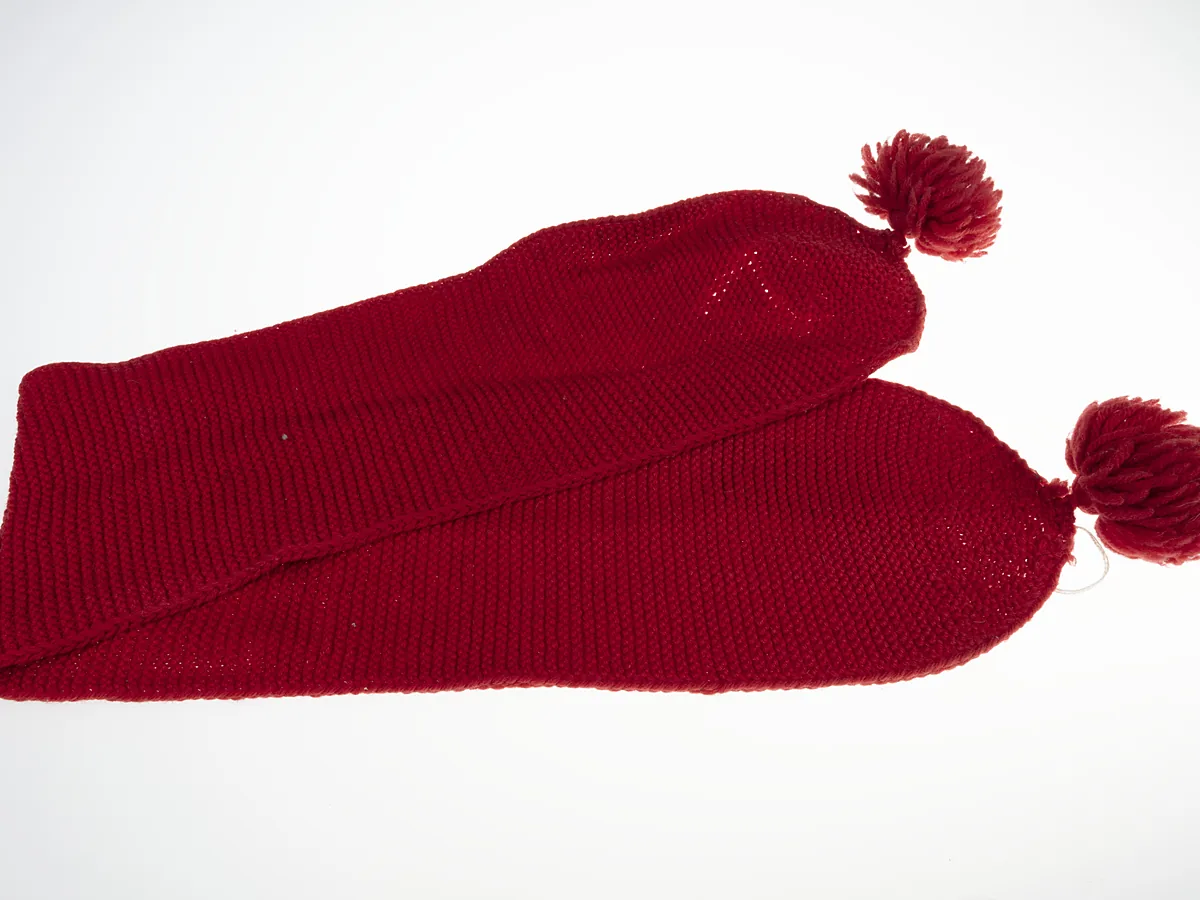
The edges curl. That is stockinette stitch doing what it always does, not a mistake. Garter stitch lies flat, which is another reason every project above starts there.
Knitting or Crochet?
Both make fabric from yarn and both are worth knowing, but they suit different starting points.
Crochet uses one hook and one live stitch, so nothing can unravel from the needle while you carry it around, and mistakes are easier to undo. It is generally quicker to produce something, and it suits shaped objects and anything worked in rounds. The starting point is crochet for beginners, and the equivalent first project is the crochet dishcloth pattern.
Knitting holds many live stitches across two needles, which is more to manage at first, but it produces a flatter, more even fabric with better drape. For scarves, blankets and anything worn against the skin, that difference is noticeable.
Neither is harder than the other. If a stitch unravelling from a needle sounds stressful, start with crochet; if the look of knitted fabric is what you want, start here. Crochet projects for the home sit in crochet home decor ideas.
Conclusion
Cast on twenty stitches of chunky yarn and knit a dishcloth. It takes an evening, it uses all three skills a first project needs, and it produces a finished object rather than a half-done scarf.
Make the same thing four times before moving on. Tension settles with repetition rather than with instruction, and the fourth square will be visibly better than the first without anything having been studied in between. The habits that decide whether any first craft gets finished are collected in beginner crafter mistakes and how to avoid them, and for presents at this scale there is DIY handmade gifts.
Frequently Asked Questions
What should a beginner knit first?
A garter stitch dishcloth or a simple scarf. Both use only casting on, the knit stitch and casting off, and neither involves shaping or counting beyond the first row. A dishcloth has the advantage of finishing in a single evening.
What yarn and needles should a beginner buy?
Chunky yarn in a light solid colour, with 8mm bamboo needles. Thick yarn shows progress quickly, a light colour makes the stitches visible, and bamboo grips better than metal while your tension is still uneven. The yarn band always states a recommended needle size.
Why is my knitting getting wider?
Stitches are being added at the edges, usually by knitting twice into the same stitch or by mistaking the loose tail for a stitch. Count at the end of every row until the number stays the same; it is almost never a tension problem.
Is knitting or crochet easier for a beginner?
Neither is harder, but crochet has one live stitch instead of a needle full of them, so nothing unravels if the work is put down. Knitting produces a flatter fabric with better drape. Pick by which fabric you want rather than by difficulty.
How long does it take to learn to knit?
Casting on, knitting and casting off take about twenty minutes to learn and a few hours to stop feeling awkward. Tension evens out over the first several hours of knitting rather than through any particular technique, which is why repeating a small project beats studying.
Featured image: Shisma / Wikimedia Commons, CC BY 4.0, title text added by OKI HERE.