How to Make a Macrame Wall Hanging for Beginners (Full Tutorial)

A beginner macrame wall hanging takes most people 2 to 4 hours and needs just two knots: the lark's head and the square knot. For a 12-inch piece you cut 20 to 24 strands of 3mm or 5mm cotton cord at 6 feet each, mount them on a dowel, then knot, fringe and trim.
What Is Macrame and Why Beginners Love It
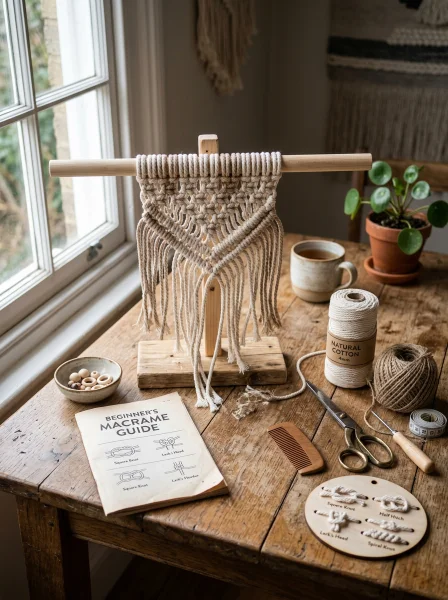
Macrame is the art of knotting rope or cord into decorative patterns. It dates back centuries but has had a massive modern revival thanks to the boho and minimalist home décor trends. The best part? You don’t need a sewing machine, special software, or expensive tools. All it takes is cord, a wooden dowel, and your two hands. Most beginners complete their first wall hanging in a single afternoon. It’s one of those fun crafts to make at home that feels impressive the moment you finish — and even more impressive when guests ask where you bought it. Macrame also makes an incredibly thoughtful present. If you’re into creating DIY handmade gifts , a custom wall hanging tailored to someone’s color scheme or style is a gift that genuinely stands out.
Materials You Need Before You Start

Getting your supplies right makes a big difference in your finished piece. You don’t need to spend a lot — many crafters source everything they need affordably, even picking up items at discount stores. If you’re budget-conscious, check out some creative dollar store crafts ideas to stretch your supplies further. Here’s what you’ll need for a basic beginner wall hanging:
- Macrame cord — 3mm or 5mm single-strand cotton cord works best for beginners
- Wooden dowel — about 12–18 inches wide
- Scissors — sharp ones make clean cuts
- A measuring tape
- A comb or stiff brush — for fringing the ends
- Optional: wooden beads for added texture and decoration
For a piece roughly 12 inches wide and 24 inches long, you’ll need approximately 20–24 strands of cord, each cut to about 6 feet (the rule of thumb is 4x the desired length for knotted sections).
How to Make a Macrame Wall Hanging for Beginners: Step-by-Step

This is the heart of the tutorial. Follow these steps carefully, and don’t worry about perfection — a slightly uneven fringe actually adds to the handmade charm.
Step 1: Cut and Mount Your Cord
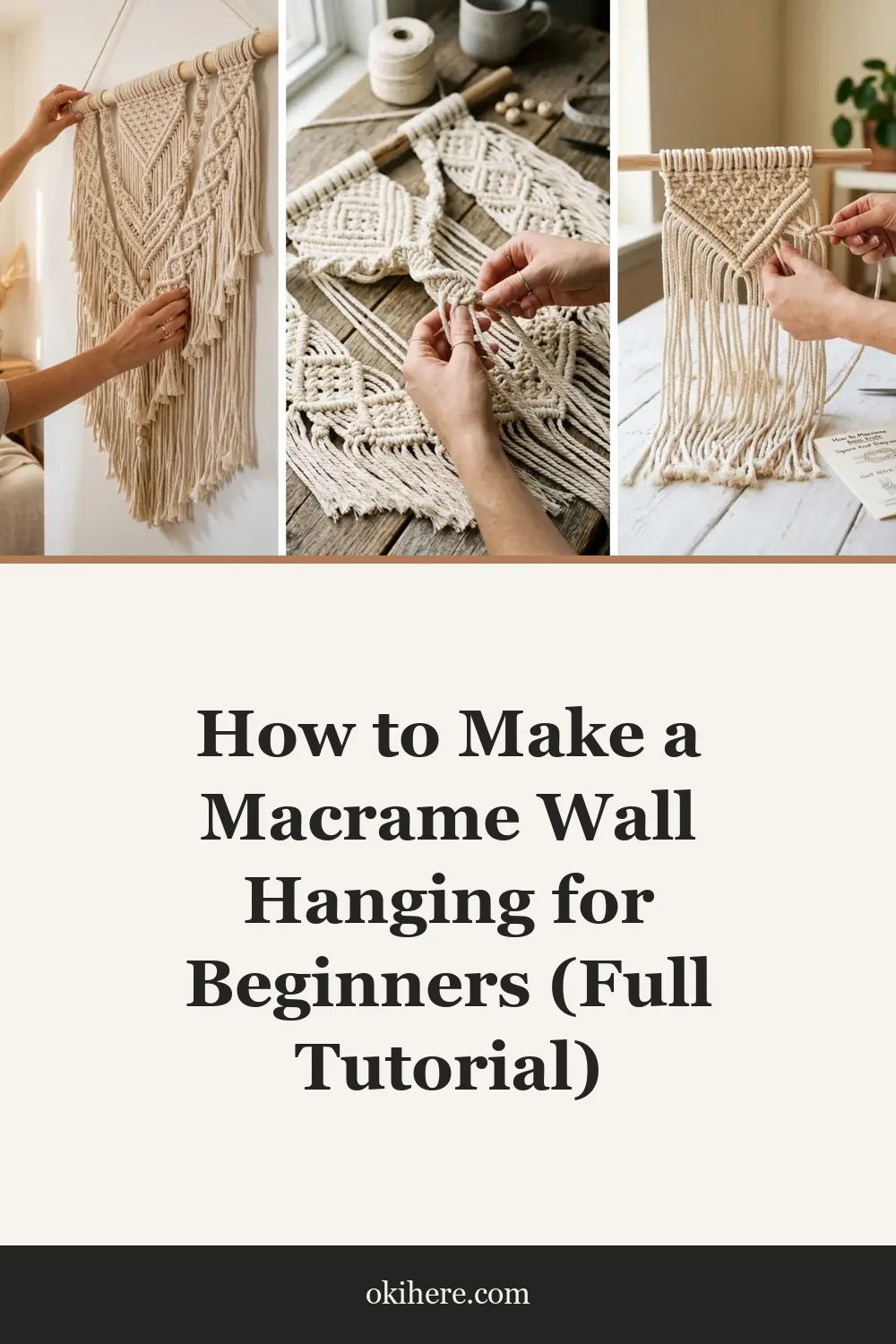
Cut all your strands to the same length — around 6 feet each. Fold each strand in half and use a lark’s head knot to attach it to your dowel. To tie a lark’s head knot: fold the cord in half, place the looped end over the dowel, then pull both loose ends through the loop and tighten. Repeat until your dowel is filled with cords.
Step 2: Learn the Square Knot (Your Foundation Knot)

The square knot is the most essential knot in beginner macrame. Take four strands — two outer working cords and two inner filler cords. Cross the right cord over the two middle cords and under the left cord. Then bring the left cord under the middle cords and up through the loop on the right side. Pull tight. That’s the first half. Repeat in reverse for the full square knot. Practice this knot a few times on loose cord before moving to your mounted piece. Once it clicks, you’ll find a rhythm quickly.
Step 3: Create Rows of Alternating Square Knots
Work your first row of square knots across all cord groups. For your second row, shift one group to the left — using two cords from adjacent groups to create an alternating diamond pattern. This is the classic macrame texture you’ve seen in décor photos. Repeat for 3–5 rows depending on how long you want your main knotted section.
Step 4: Add a Spiral Knot Section (Optional but Beautiful)
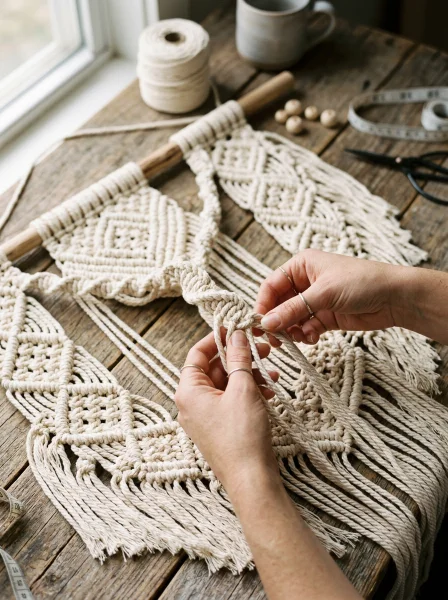
The half square knot spiral (also called the spiral stitch) adds gorgeous visual interest. Simply repeat only the first half of a square knot over and over without alternating sides. The cords will naturally twist into a spiral after 4–6 repetitions. This works especially well on the outer sections of your wall hanging.
Step 5: Create the Fringe
Once you’ve finished your knotted sections, leave the remaining cord lengths hanging loose. Use sharp scissors to trim the ends into your desired shape — straight across, a V-shape, or an angled diagonal all look great. For a fluffy, boho-style fringe, use a fine-tooth comb or stiff brush to unravel and brush out the cord fibers until they become soft and feathery.
Step 6: Final Touches and Hanging
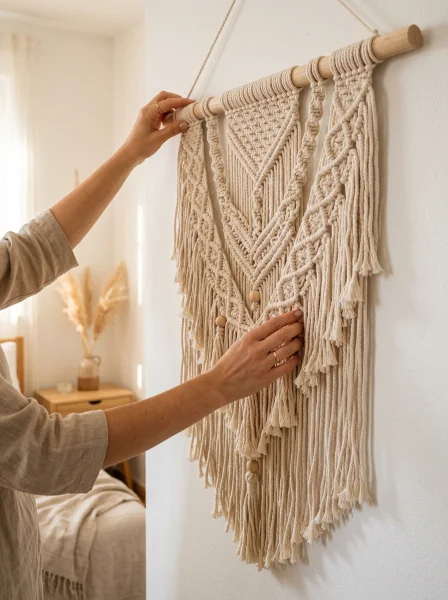
Trim any uneven strands. You can steam the fringe lightly with a clothing steamer to straighten it out if needed. Tie a loop of cord around each end of the dowel for hanging. Step back and admire your work — you’ve just completed your first macrame wall hanging.
Beginner Tips to Make Your First Piece Look Professional

A few small habits separate a polished wall hanging from a messy one. Keep these in mind as you work:
- Keep tension consistent — knots pulled at different tightnesses create uneven rows
- Work on a flat surface or hang your dowel from a hook while you knot — gravity helps keep things aligned
- Measure twice, cut once — running out of cord mid-piece is frustrating
- Start simple — resist the urge to add too many knot types in your first piece
- Use a color that complements your wall — natural cotton works in almost any space
Macrame is also a great gateway into other home craft projects quick and easy enough to tackle on weekends. Once you nail wall hangings, you might find yourself branching into plant hangers, table runners, or even macrame bags.
Creative Variations to Try After Your First Piece
Once you’re comfortable with the basics, there are dozens of ways to level up your designs. Dip-dyeing your cord in pastel or earth tones adds a gorgeous gradient effect. Weaving in dried pampas grass, feathers, or dried flowers creates a more organic, textural look. You can also experiment with different cord thicknesses. Thicker cord (8mm+) creates bold, chunky statement pieces, while thinner cord (1–2mm) lets you create intricate detailed patterns. And if you’re planning to give your creation away, a beautifully made wall hanging ranks among the best handmade gift craft ideas for housewarmings, birthdays, or holidays. Don’t be afraid to sketch out your design on paper before you start. Even a rough layout of where you want knot sections versus fringe sections saves a lot of guesswork during the actual crafting process.
Pattern Upgrades Beyond Straight Rows
Straight rows are not the only way to build a design. Instead of working every row flat across, start with your center four cords and work outward, dropping each new knot down slightly. The pattern settles into a V-shape. Reverse that V — working from the outer edges back toward the center — and the two halves close into a diamond, which makes a strong focal point in the middle of a piece.
The gathering knot is the other easy upgrade. Wrap one cord tightly around a group of cords three or four times, then thread the end through the back to secure it. It bundles the cords together and creates a clean visual break between sections. Beads work as punctuation in the same way: thread wooden beads onto individual cords between knots, or use a large wooden ring as a structural element.
Troubleshooting Common Macrame Mistakes
Most first-piece problems come down to a handful of causes, and all of them are fixable while you are still working:
- Curling or wonky rows — the tension is inconsistent. Counting to three while you tighten each knot helps you pull every one with the same pressure.
- Running short on cord — lay a new length alongside the short one and work both into the next few knots. The join disappears once that section is finished.
- Crooked patterns — measure as you go and use a ruler to check the spacing between rows. Drawing guidelines on paper and knotting over them keeps everything square.
- A knot you want back — macrame is forgiving. Untie back to the mistake and redo it, and check your progress often so errors surface while they are still one or two knots deep.
Buy more cord than the math says
The 4x rule covers straight rows of square knots. Patterns packed with knots eat more than that, so multiply the finished length by five or even six. You can always trim excess, but adding cord mid-piece is fiddly, so buy around 20% more than your calculation suggests.
Write the numbers down after every project: cord length cut, number of strands, finished size. A short cord log turns the next piece in the same pattern into a measured job instead of a guess.
Cord quality shows in every knot
Cheap synthetic cord frays as you work and makes knots look sloppy no matter how even your tension is. 100% cotton, either single-twist or 3-ply, holds knots firmly and is gentler on your hands during a long session. Before buying in bulk for a big piece, test a small sample: pull and twist it, then check for consistent thickness and minimal shedding.
Store cord in a sealed container. Dust and tangling are what make a fresh piece look tired before it is even finished.
Mount the dowel straight before you tie anything
A crooked foundation hangs crooked however good the knots are. Use a level when you position the dowel, and secure it firmly at a comfortable working height. Mark the cord positions along the dowel with small pencil dots first, which is the easiest way to get even spacing across the full width.
Photograph the stages
Take a photo at each major stage and note the cord lengths, knot counts, and anything you changed along the way. That is the difference between being able to make the piece again and starting from scratch every time.
Hanging and Caring for Your Finished Piece
A finished wall hanging is heavier than it looks, so choose a hook that can carry the weight rather than a small adhesive one. Hang it where the light is indirect, since direct sun fades cotton cord over time, and keep it out of humid rooms such as bathrooms unless you worked with synthetic cord. If the brushed fringe frizzes, a light pass of fabric stiffener spray settles the fibers and holds the shape.
Conclusion
Learning how to make a macrame wall hanging for beginners (full tutorial) is one of the most rewarding craft skills you can pick up. It’s affordable, meditative, and the end result is something genuinely beautiful that you made with your own hands. Start with a simple square knot pattern, get comfortable with your cord, and don’t overthink the process. The key takeaway here: macrame is more forgiving than it looks. Small imperfections are part of the handmade charm. Your first piece doesn’t need to be perfect — it needs to be finished. Once you hang it on your wall and see it every day, you’ll be itching to make the next one. Ready to start knotting? Gather your supplies, clear some space on your dining table, and give yourself an afternoon. You might just discover your new favorite hobby. Did you try this tutorial? Drop a comment below and share how your first macrame wall hanging turned out! Tag your photos and let the community see your work — beginners and experienced makers alike love seeing fresh creations. Share this guide with a crafty friend who’d love to try it too.
Frequently Asked Questions
Q: How long does it take to make a macrame wall hanging for beginners? A: Most beginners complete a simple wall hanging in 2–4 hours. If you’re learning the knots as you go, budget a full afternoon. Simpler designs with fewer knot variations go faster, while more intricate patterns can take a full day or weekend. Q: What is the best cord size for a beginner macrame wall hanging? A: 3mm or 5mm single-strand cotton cord is ideal for beginners. It’s thick enough to see your knots clearly, soft enough to work with comfortably, and unravels beautifully into fringe. Avoid synthetic cords at first — they’re slippery and harder to knot consistently. Q: How to make a macrame wall hanging for beginners without a dowel? A: You can use a sturdy branch, a metal pipe, a thick bamboo stick, or even a piece of driftwood as a substitute for a wooden dowel. The only requirement is that it’s strong enough to hold the weight of your cords without bending. Natural branches add a lovely rustic touch to the finished piece. Q: How much cord do I need for a beginner macrame wall hanging? A: For a standard 12-inch wide piece, plan on using about 20–24 strands cut to 6 feet each, which equals roughly 120–144 feet (about 40–50 meters) of cord total. It’s always smart to cut a bit extra — you can trim excess, but you can’t add length mid-knot. Q: Can I follow a full tutorial on how to make a macrame wall hanging for beginners using only basic knots? A: Absolutely. The lark’s head knot and square knot alone are enough to create a stunning wall hanging. Many experienced macrame artists create entire collections using just these two knots in different configurations. Master the basics first before adding more complex techniques like the josephine knot or gathering knot.